
Magnetism induced by manufacturing
Many industrial processing carried out on ferromagnetic metals cause an induced magnetization. Some of these are: clamping with magnetic chucks, bending, rubbing/abrasion/friction between pieces and tools.
Magnetic field induced by non-destructive testing
Magnetic Particles Inspection and Eddy Current Testing are used for steel pipes and bars control. Despite the demagnetization usually applied downstream of these processes, the piece can maintain a magnetic residue.
High residual magnetism at the end of the production cycle?
Despite the magnetization following nondestructive testing, sometimes the level of magnetic residue remains too high. In this case, your clients will unlikely accept the piece, as it does not comply their needs.
Why does magnetism still remain inside of the part? For various reasons: for example, the piece may have undergone manipulation after quality controls or it may have been accidentally exposed to further magnetic fields. Again, the magnetism may have remained due to the controls themselves.
Eddy currents: unfortunately, the core of the piece remains magnetic
Despite the magnetization following nondestructive testing, sometimes the level of magnetic residue remains too high. In this case, your clients will unlikely accept the piece, as it does not comply their needs. Why does magnetism still remain inside of the part? For various reasons: for example, the piece may have undergone manipulation after quality controls or it may have been accidentally exposed to further magnetic fields. Again, the magnetism may have remained due to the controls themselves..

High residual magnetism at the end of the production cycle?
Despite the magnetization following nondestructive testing, sometimes the level of magnetic residue remains too high. In this case, your clients will unlikely accept the piece, as it does not comply their needs.
Why does magnetism still remain inside of the part? For various reasons: for example, the piece may have undergone manipulation after quality controls or it may have been accidentally exposed to further magnetic fields. Again, the magnetism may have remained due to the controls themselves.
Eddy currents: unfortunately, the core of the piece remains magnetic
Despite the magnetization following nondestructive testing, sometimes the level of magnetic residue remains too high. In this case, your clients will unlikely accept the piece, as it does not comply their needs. Why does magnetism still remain inside of the part? For various reasons: for example, the piece may have undergone manipulation after quality controls or it may have been accidentally exposed to further magnetic fields. Again, the magnetism may have remained due to the controls themselves..
Steel welding, chrome plating, nickel plating and washing: the compromised processes
Magnetism affects various processing stages, making them difficult and sometimes impractical. If the piece is magnetic, welding will be problematic due to arc deviation. Several surface coatings are significantly impacted by residual magnetism. Chroming and nickel plating are particularly prone to defects caused by residual magnetism. Notably, nickel plating can develop needle-like deposits that compromise the aesthetic quality of the work.
Problems in processing steel pipes and bars?
If you find it difficult perform particular processes or you notice unpleasant defects at the end of the operations, residual magnetism could be the cause. You have to eliminate it: magnetic or flawed pieces could have a considerable impact on the processing costs!
Problems in processing steel pipes and bars?
If you find it difficult perform particular processes or you notice unpleasant defects at the end of the operations, residual magnetism could be the cause. You have to eliminate it: magnetic or flawed pieces could have a considerable impact on the processing costs!
Steel welding, chrome plating, nickel plating and washing: the compromised processes
Magnetism affects various processing stages, making them difficult and sometimes impractical. If the piece is magnetic, welding will be problematic due to arc deviation. Several surface coatings are significantly impacted by residual magnetism. Chroming and nickel plating are particularly prone to defects caused by residual magnetism. Notably, nickel plating can develop needle-like deposits that compromise the aesthetic quality of the work.

Non-stainless steel: the best known among ferromagnetic metals
You’ll probably already know it, but most of the steels you work daily (except for stainless steel) are naturally ferromagnetic, which means, simplifying, that they are attracted to magnets. This happens because steel is an alloy composed of carbon and iron; the latter is one of the main ferromagnetic substances.
Residual magnetization is a non-conformity in supply!
A high magnetic residue is considered a defect and a supply problem: by not respecting the current production parameters and the regulations, it will be difficult to market your pieces in many sectors.
Make sure that the level of magnetization of pipes and bars is within the supply specifications and satisfies the technical specifications, for example:
- EN 10228-1, applied to forged pieces, requires a maximum magnetism of 800 A/m (about 10 Gauss)
- EN 1290 applies to welds controlled with Magnetic Particle Inspection and suggests 400 A/m (about 5 Gauss)
- VPI09, for railway structures controlled with Magnetic Particle Inspection, requires 400 A/m (about 5 Gauss)
- According to the API 5L, regulation of the American Petroleum Institute that defines the standards of the pipes (Standard Line Pipe) for the gas, water and oil transport, the level of magnetism should be less than or equal to 3.0 mT (30 Gauss) and in any case it should not exceed 3.5 mT (35 Gauss)
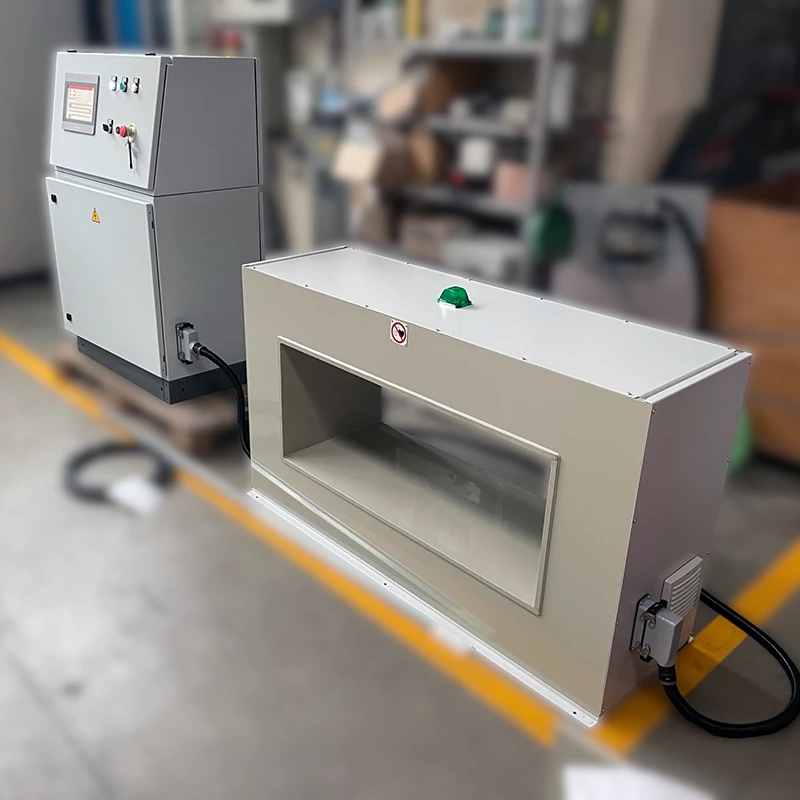
The solution? Our low-frequency industrial demagnetizer
With our low-frequency industrial demagnetizer, you will significantly reduce residual magnetism. It has an intuitive touchscreen interface; the machine degauss the pieces reaching a deep level and makes them ready for processing and subsequent uses.
Functionality combines with efficiency: you can demagnetize industrial components, especially large diameter pipes and bars, in single or bundled pieces, optimizing your time and saving money!
Do you need assistance in removing residual magnetization?
Contact our experts to analyze your case and find the right solution.